
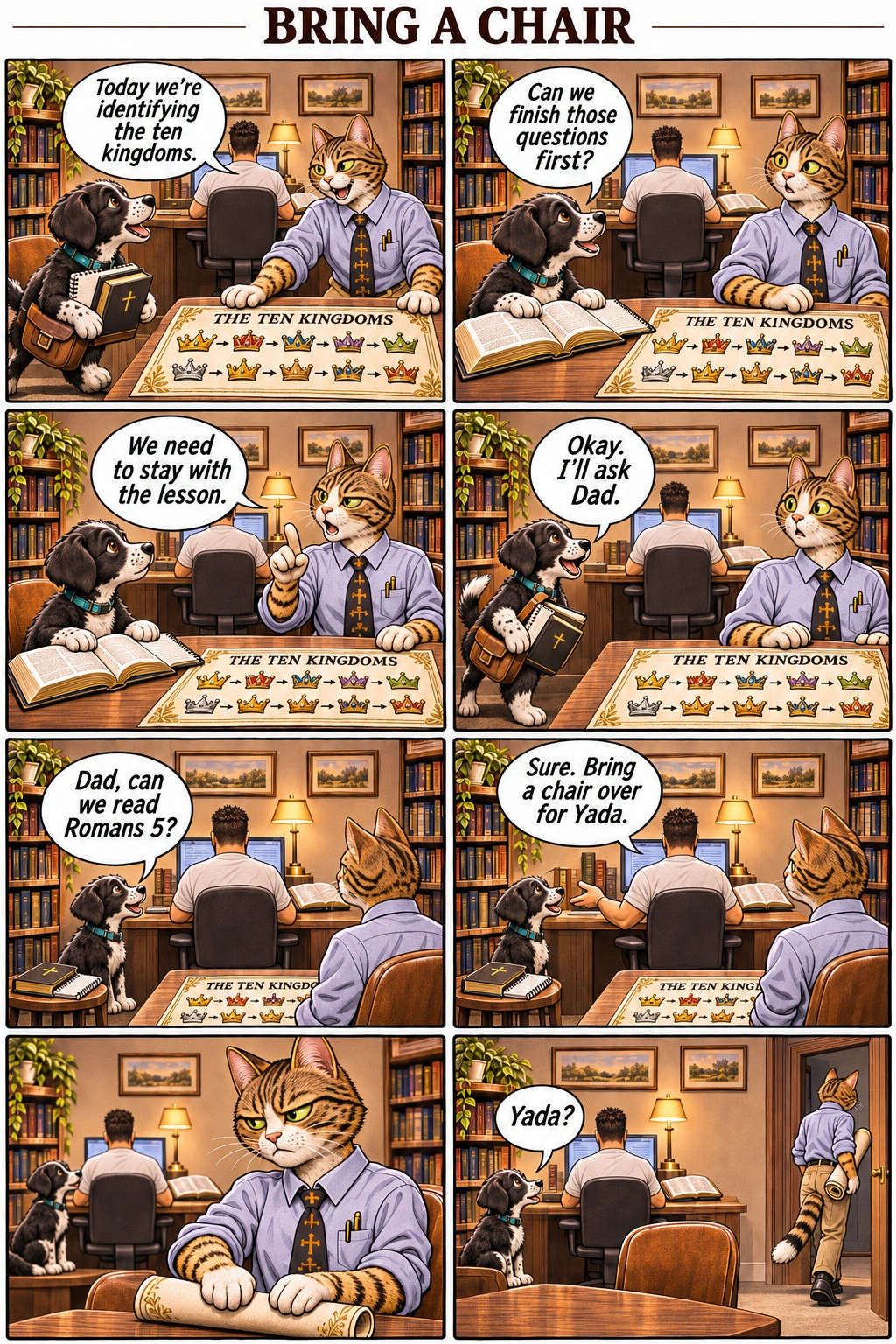
Bring a Chair
Competence in one area does not remove the need for instruction in another. A teacher can have real ability, useful experience, and an incomplete understanding at the same time. The church benefits when those gaps can be addressed without turning every explanation into a struggle over position.
Acts 18:24–28 introduces Apollos with considerable respect. He is eloquent, mighty in the Scriptures, instructed in the way of the Lord, and fervent in spirit. He speaks and teaches accurately about Jesus. Luke also identifies a limitation: Apollos knows only the baptism of John. The account does not require us to choose between recognizing his strengths and acknowledging that he needs further instruction.
Priscilla and Aquila hear him speak boldly in the synagogue. They take him aside and explain the way of God more accurately. They engage the substance of his understanding. Their response does not treat a gap as proof that everything he has taught is worthless, and it does not treat his public ability as a reason to leave the gap alone.
That distinction matters when we help people who already carry responsibility. A correction that identifies a specific omission gives the learner something to investigate. A broad attack on his intelligence or character may obscure the actual matter. We should be able to say what requires explanation and show how the fuller account follows from Scripture.
Luke then describes Apollos going to Achaia, where he greatly helps believers and demonstrates from the Scriptures that Jesus is the Christ. The narrative moves from his incomplete understanding through further explanation to useful service. Being taught has served his ministry. Protecting the appearance that he needed no help would have withheld something beneficial from the people he went on to serve.
Second Timothy 2:1–2 similarly presents teaching as something received and entrusted. Timothy has heard Paul's instruction and is to commit it to faithful people able to teach others. Each teacher belongs within a chain of learning. The ability to pass on the truth depends upon receiving it responsibly rather than treating knowledge as something a teacher must appear to have generated alone.
A student's question may reveal where our own learning needs to continue. We can say what we know, identify the part we cannot yet explain, and seek help from someone able to address it. That response models a useful habit. The student learns that Christian teaching answers to truth beyond the teacher's immediate performance.
There is also a responsibility on the person offering help. We should explain rather than merely display superior knowledge. Read the passage together. Identify the connection that was missed. Give the other person enough of the reasoning to understand and use it. The aim is increased understanding, not a room full of witnesses to our cleverness.
The details of the encounter with Apollos prevent us from making teachability a virtue reserved for beginners. Luke has already described him as mighty in the Scriptures. If a person with that commendation can need a more accurate explanation, no useful ministry provides a permanent exemption. Understanding has breadth and depth. We may explain one passage well while overlooking a connection elsewhere, and we may communicate clearly while relying on an assumption that deserves further examination.
The setting also gives us reason to make instruction personal where possible. Priscilla and Aquila take Apollos aside. The text does not turn their conversation into a contest before the synagogue. A private explanation can allow questions to be asked without requiring every sentence to defend a public position. That does not mean public error never needs public correction. It means the way help is offered should serve understanding rather than manufacture an audience for the helper's achievement.
Those who learn from us benefit when they see this process working. A teacher can return to a question and say that someone helped him understand it more accurately. He can identify what he previously missed and show the textual reason for the change. That response gives students a usable example of careful revision. It also releases them from the false expectation that maturity means never needing another person's assistance. The church's shared life includes the help by which its teachers become more useful.
Teachers who continue learning gain resources for the next conversation. They can revise an illustration, correct an explanation, or distinguish two ideas they previously confused. That growth does not require pretending their earlier account was already complete. It requires valuing the people who need a better account more than the image of never having needed one ourselves.
Take the offered place at the table. Listen carefully, ask the question that follows, and check the explanation against the text. The work of teaching gives us strong reasons to keep learning. The people we serve deserve the benefit of what someone else can help us understand.