
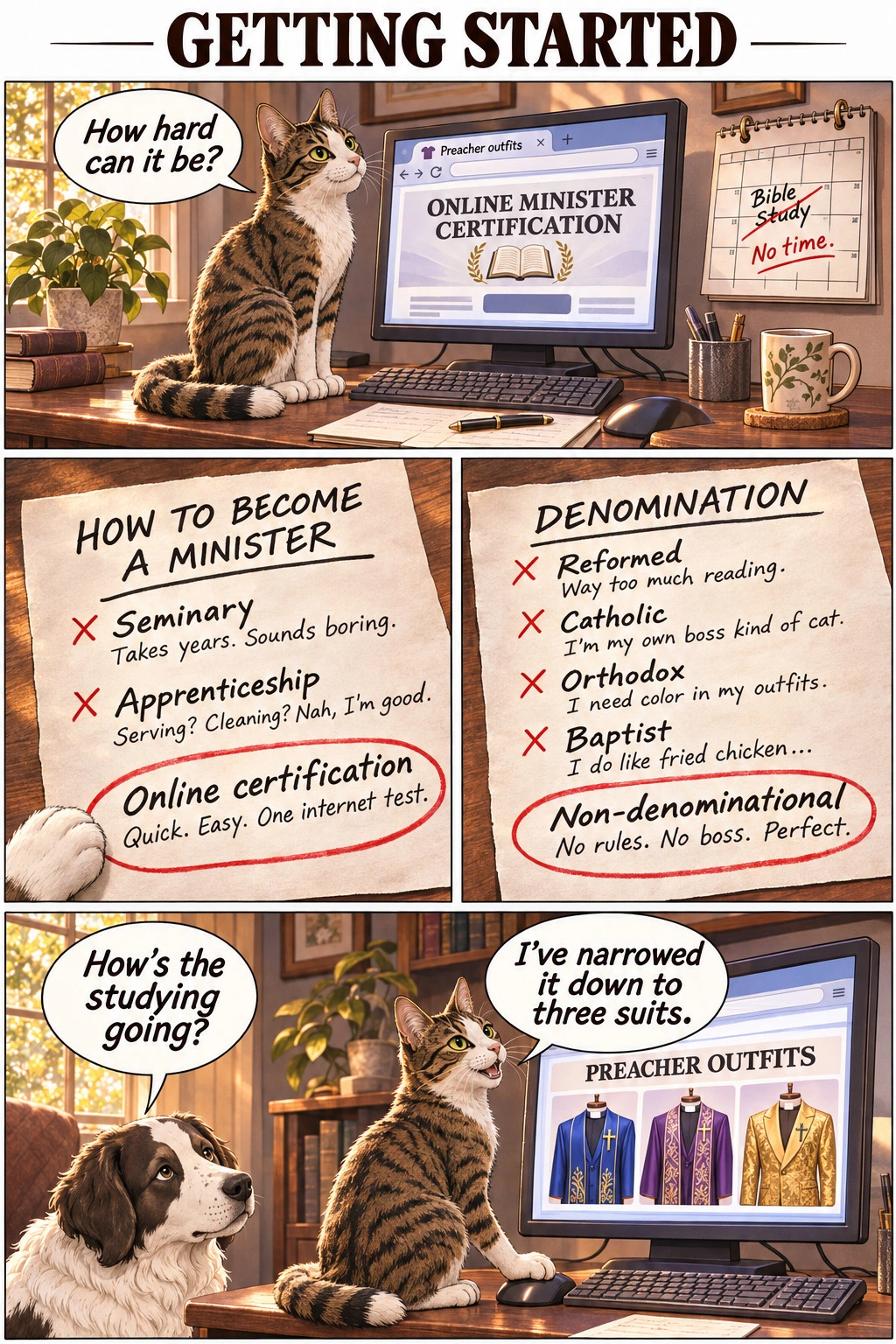
Getting Started
A ministry credential can tell us that a person completed a process. It cannot, by itself, tell us whether that person is trustworthy, self-controlled, gentle, or able to explain Scripture. The church needs evidence of the qualities that the work requires. Replacing that examination with a certificate confuses permission to use a title with readiness to care for people.
First Timothy 3:1–7 begins by recognizing the desire to oversee a congregation as a desire for good work. Paul immediately describes the person qualified to do it. His attention falls heavily on character: an overseer must be above reproach, temperate, sensible, hospitable, gentle, and free from the love of money. He must be able to teach, manage his household responsibly, and have a good reputation with outsiders. These are observable qualities, not entries that become true when someone submits an application.
Consider how those qualities become visible. Gentleness matters when someone challenges us. Self-control matters when we are tired or denied something we want. Hospitality involves making room for people who need attention. Freedom from the love of money becomes relevant when leadership offers opportunities for gain. A congregation learns about these things through a person's ordinary conduct over time.
Paul also excludes a new convert because pride can lead him into condemnation. The warning is particularly relevant when someone is excited by a new identity. Enthusiasm can be sincere while judgment remains immature. Giving a person authority before he has learned to receive instruction may strengthen precisely the pride that makes him dangerous to others. Time spent growing as a Christian is part of preparation for responsibility.
Titus 1:5–9 makes the teaching requirement more specific. The overseer must hold firmly to the faithful word so that he can encourage others in sound teaching and answer those who contradict it. He therefore needs more than fluency in familiar religious phrases. He needs to understand the message he is entrusted to explain and be able to distinguish it from competing claims.
That ability can be examined. Ask a prospective teacher to explain a passage in its context. Ask how his conclusion follows from the words. Ask what he would do if a student raised an objection he could not answer. These questions do not require someone to know everything. They reveal whether he can work responsibly with what he knows and handle the limits of his knowledge honestly.
First Timothy 5:22 warns Timothy against laying hands on anyone hastily. Recognition of leadership is a serious responsibility because the people doing the recognizing share responsibility for what they endorse. A church that rushes past known concerns cannot later treat the appointment as though it were somebody else's problem. Careful examination protects the congregation and the person being considered.
First Peter 5:1–4 addresses elders already exercising responsibility. They are to shepherd God's flock willingly, without greed, and through example rather than domination. Peter identifies the people as God's flock and Jesus as the chief Shepherd. Leadership is therefore a stewardship exercised under another's authority. It does not turn the congregation into the leader's possession or make his preferences the final standard for its life. Preparation for such work includes learning to exercise responsibility without treating people as instruments of personal success.
A person's willingness to remain accountable is particularly revealing here. If every question about readiness is treated as an attack on God's calling, the church is prevented from doing the examination the apostolic instructions require. An internal conviction cannot cancel a public qualification. The congregation must still consider the life it can observe, and the person seeking responsibility must still answer concerns that arise from that life. A trustworthy candidate can recognize the legitimacy of the process even when its conclusion is disappointing.
Titus 1:10–11 explains why these safeguards matter. Paul describes rebellious talkers and deceivers whose teaching disrupts whole households, sometimes for dishonest gain. An overseer's ability to encourage sound teaching and answer error is needed because people can be harmed by what they receive. The qualifications protect actual families and actual faith. Treating preparation as an obstacle to be bypassed misunderstands both the responsibility of the office and the vulnerability of the people entrusted to it.
Formal education can help develop understanding, and supervised service can expose weaknesses that a classroom never reaches. Neither functions automatically. A long course does not create integrity, and a short course does not establish competence. The relevant question is whether preparation has produced the character and ability Scripture requires. The method serves that goal; it cannot replace it.
Those seeking leadership should welcome a process that can also say no. Ask mature Christians what they have observed. Receive responsibilities appropriate to your growth. Let people see how you respond to disappointment, correction, and work that carries no prestige. A title obtained quickly may impress strangers. A faithful life and a sound explanation give a congregation reasons to trust you.